First published on Tech Skeptic Goes Electric, February 24, 2025
If you’ve followed this Substack for a while you’ve probably noticed that I don’t jump into every new technology as it becomes available. I spend some time studying it… thinking about it… and deliberating before I make a decision. I take my time because I know that when I adopt a new technology, my life is going to change.
Lots of marketing teams use this to their advantage. They proudly proclaim a variety of ways in which my life will assuredly get better if only I use their product. But I know that the hype is rarely ever true. And even if the benefits are as good as advertised, there will be other changes that I’m going to have to make to my life to access those advantages.
So when we decided we wanted an EV, I looked for one that would require as little change as possible. Because we were ready to make a pretty major shift – from gas to electric – I was hoping to keep as many other things as close to normal as possible. So we chose a car that is kind of slow compared to other EVs. We chose a car with only one motor… placed pretty much where the engine would be. We chose a car with an actual button that turns the radio on and off. And we chose a car that can be set so that the accelerator and brake respond pretty much the same way they do in our older gasoline powered car. Yes it’s an EV, but it’s an EV that doesn’t radically change the process of driving. Not only are these things very familiar, they mean that when I’m sitting in the driver’s seat and need to suddenly respond to an emergency situation, my brain can respond in the way it always has before.
Looking back on what I’ve learned over the past year, I do think this was a wise decision. As I’ve noted before… the closer your new car is to what you’re used to, the safer the transition.
It has made me wonder, however… am I missing out?
I recently got a little taste of what I’ve been missing. Over the holidays my father-in-law was very excited to show me his brand new EV. He opened the garage door and I got my first look. It was shiny, swoopy, and candy apple red with bold black wheels. It was beautiful. A smile swept across his face and he handed me the keys.
Actually… that’s not what happened. That’s what I assumed he was about to do. But his EV is very much not like mine. It wasn’t designed to mimic the experience of a car from 2010. The team that designed it embraced the idea of making the car feel like the future. So there certainly was a smile on my father-in-law ’s face, but there was no key in his hand. Instead he held up a small black plastic card.
Over the next hour or so he slowly introduced me to his new EV and how to drive it. I won’t go so far as to say that everything was different… but without his mentorship or a deep dive into the owner’s manual, I don’t think I would have gotten out of the garage. This was “not my father’s Oldsmobile.” It was something very, very different.
The card, as you probably suspected, was indeed the key. When held against the “B-pillar” (the metal that separates the driver’s window from the passenger’s window) the car door unlocked and the flush handle popped out, allowing me to open the car. Would I have figured this out without help? Probably. I’m guessing I would have started by waiving it over the handle and perhaps on the passenger side door. But eventually I’d find that the magic only works on the driver’s side B-pillar.
Once seated, I was told to lean the key card on a slanted fuzzy shelf to the right of my knee. It was a very helpful instruction. I’m pretty sure I would have looked for a credit card slot in the dashboard to slide it into instead.
At this point I figured I could handle things by myself. After all, I’ve driven fancy cars without keys. I know that all I have to do is find that start button and we’ll be on our way. Except…
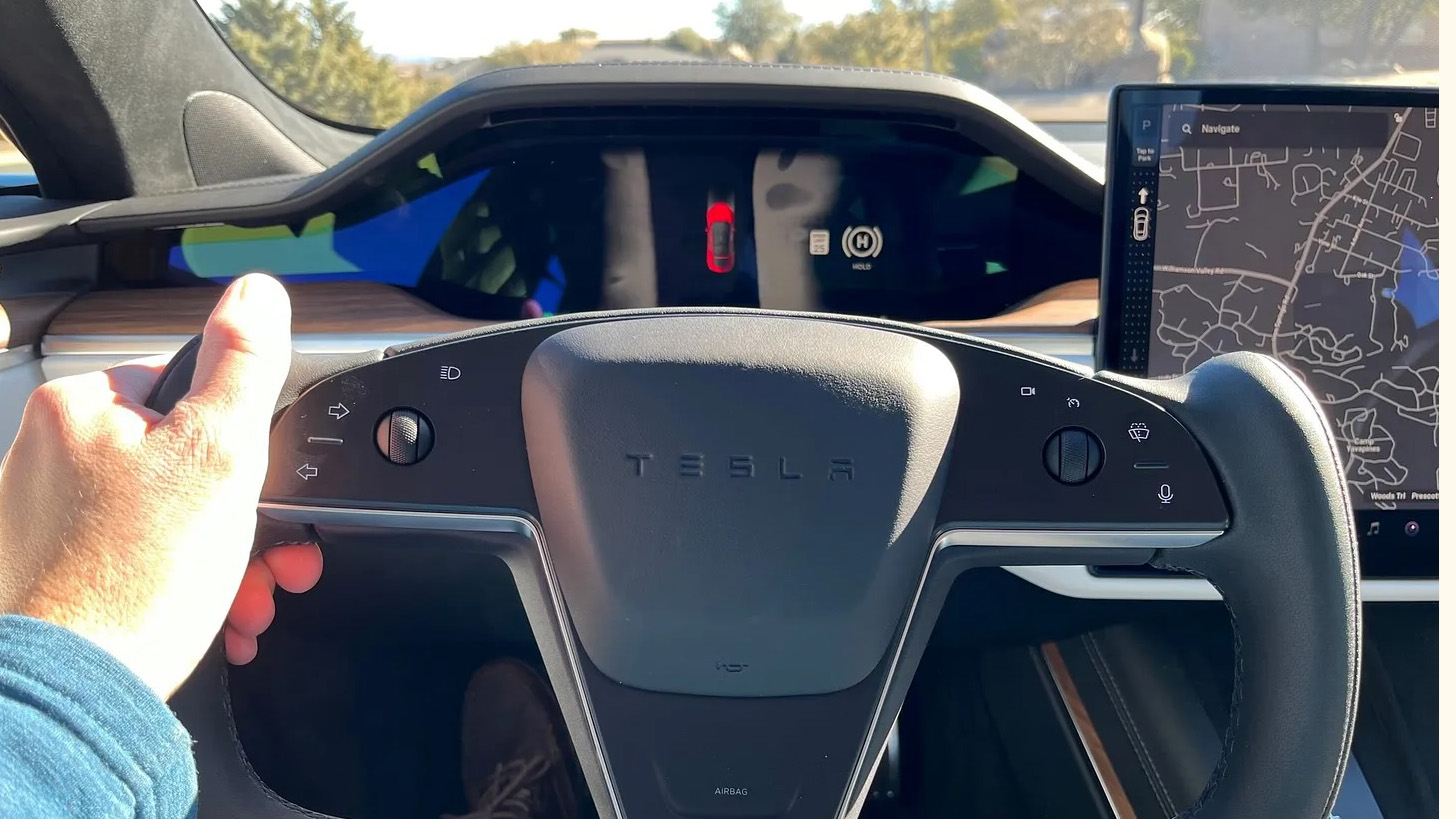
There is no start button. In fact, I don’t think there are any buttons at all. And it’s not just the buttons that have disappeared. The gear shift and turn signal stalks are also missing.
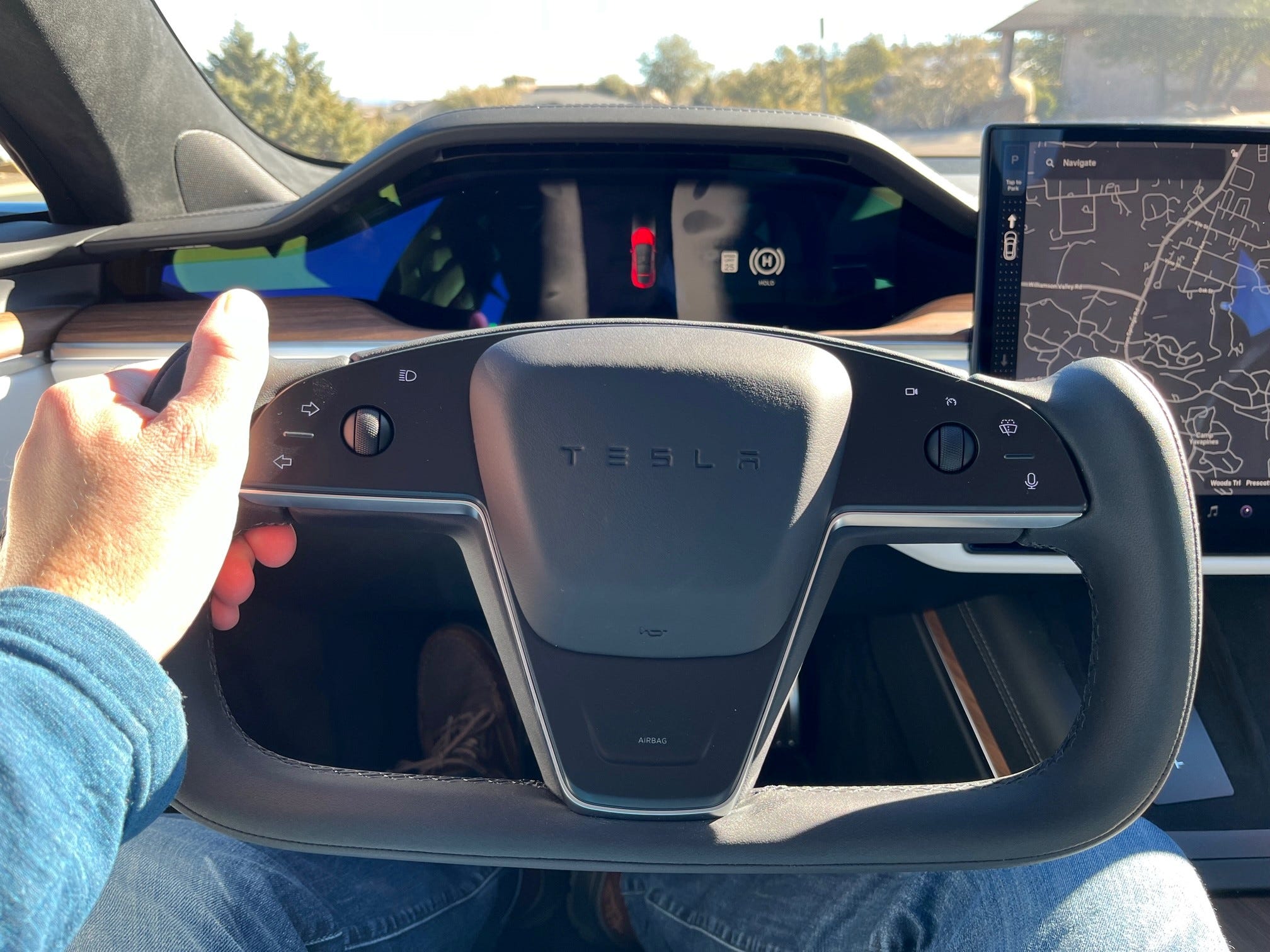
Thankfully, my father-in-law was ready to give me further orientation. I could still turn on the turn signals, the lights, and windshield washer fluid. All I had to do was look at the steering wheel, find the corresponding logo (i.e. left arrow for left turn) and gently place my finger on top of it. The controls are capacitive surfaces that vibrate just a little bit when you touch them. If you always put your hands on the same place on the wheel, you might be able to memorize where the different controls are. Otherwise, you have to glance down from the road to find them. As this was a brand-new car to me, I spent a lot of time glancing down.
Finally we were ready to go. What next? “Push the brake.” Push the brake? “Yes, push the brake.”
So I pushed the brake and the screen on my right changed its display. It now had a vertical line on the left side closest to me. “If you want to go forward, you swipe up. If you want to go backward, you swipe down.” Fortunately, I left the dating pool before I had to learn how to “swipe left” or “swipe right.” But when I drive this car I get to practice swiping up and down.
I took my right hand off the wheel, looked at the screen to my right, dragged my finger down it, and the car shifted into reverse. Ironically, with some EV enthusiasts excitedly relying on one pedal driving, the only time they might ever push the brake pedal on a car like this is when they want to go. We might have to come up with a new name for that pedal.
Now that I was moving I had full attention on the steering whee… actually there was no steering wheel. This car is equipped with a steering yoke. It’s basically a big rectangle that sat in front of me. It felt like I was ready to pilot a Cessna or perhaps an F1 car. There’s a great benefit in that none of it covers the instrument display in front of me. I had a clear view, at least until I tried turning the wheel… I mean yoke.
Using this steering yoke was a bit of a challenge for me. I’ve always been a “10 o’clock / 2 o’clock” driver. I.e., I place my hands at the positions where the “10” and “2” are on a clock. That’s not an option with this yoke. You really are only given one position to put your hands: 9 o’clock and 3 o’clock. If that’s not what you normally do, you adapt or you don’t get to steer.
I’m pretty sure I’m not the only one who doesn’t drive at “9 and 3.” I remember hearing stories that Italian race car drivers back in the 50s and 60s would put both hands at the bottom of the wheel and shuffle back and forth to turn. And when air bags were first installed in steering wheels some advocates argued that you should place your hands at the 8 and 4 o’clock positions so that your arms would be launched towards the seat cushion rather than into your face if the air bag did deploy.
The cool thing about the yoke is that it does look like you’re driving an F1 car. But a yoke works in an F1 car because the driver never has to spin it in a complete circle. F1 cars have a “steering ratio” of something like 10:1, which is much smaller than that of a normal cars. That means that for every 10 degrees you turn the steering yoke, the wheels turn 1 degree. At high speeds and in big turns, you don’t have to move the steering yoke very far to get a big response. In fact, F1 drivers rarely ever need to turn their steering yokes more than 90 degrees in a given race.
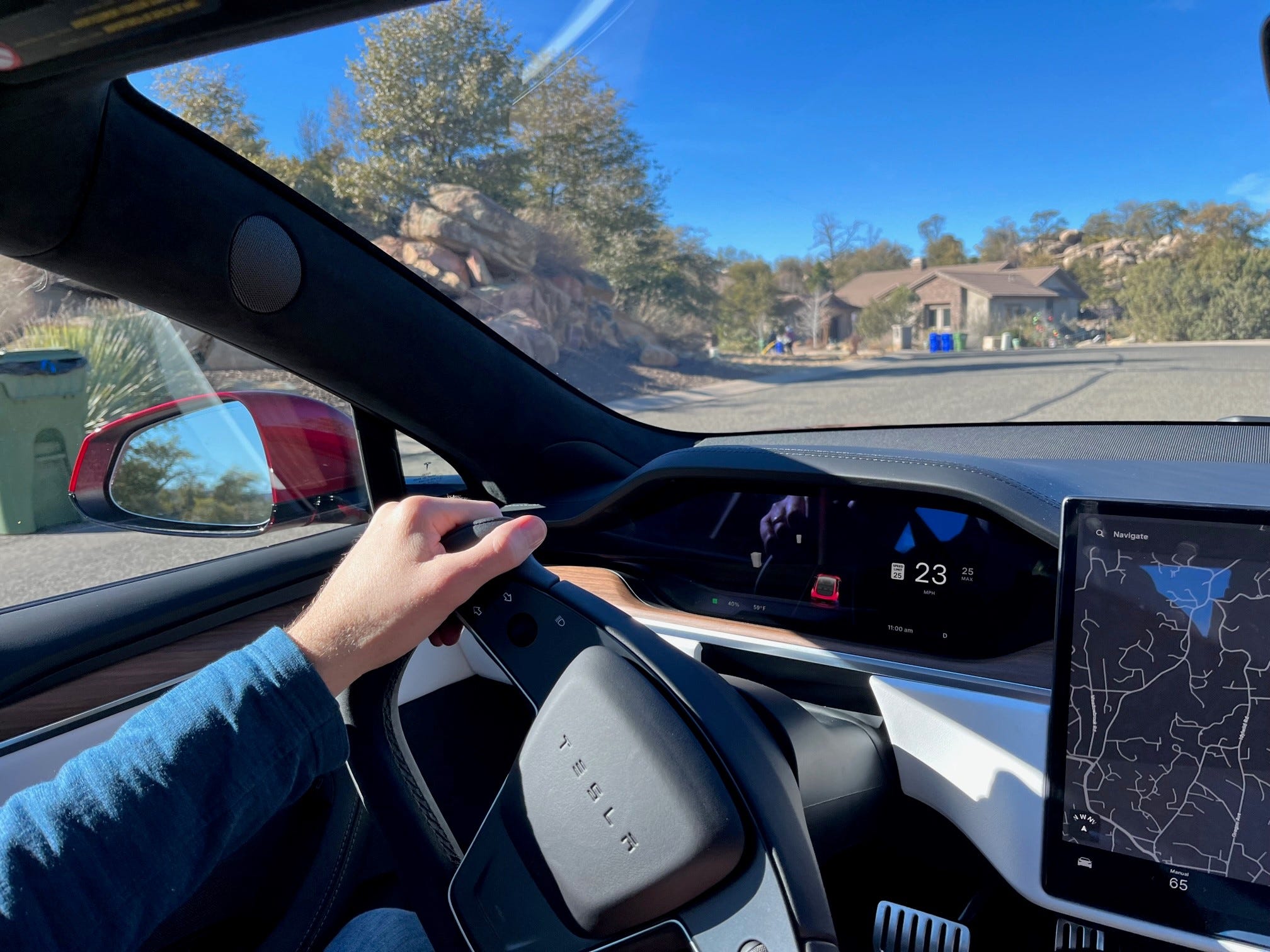
The EV I was driving has a steering ratio of 14:1, which is quite a bit bigger than an F1 car. Plus, unlike an F1 car, you’re probably going to be spending time driving your passenger EV in grocery store parking lots. For a sharp turn you have to turn the wheel 360 degrees. This results in two things: First, you absolutely have to take your hands off the yoke and find another way to turn it. I found my hands looking for the “wheel” and pushing down on the crossbar quite a lot. And second, when I was turning the wheel I had no idea where my turn signals were. I kind of gave up on them for a bit.
The good news with all of this is that after our short jaunt in the car, we made it safely back home. I even managed to make a turn using “one pedal driving” and didn’t touch the brake pedal. On the whole I really enjoyed the experience. It wasn’t exactly like driving a spaceship. But it was certainly closer to a spaceship than my car. If I had to sum up the way things looked and the way things responded, I’d simply have to say: “it was cool!”
But I did feel significantly less safe in this car than my own car. The lack of actual buttons meant that I had to keep looking away from the road. Relying on a touch screen to select the gears felt really awkward. And the steering wheel worked great at highway speeds, but was cumbersome when navigating any tight turn. I was not brave enough to try to turn the radio on while driving.
I can definitely see why some people are drawn to all the gadgets this car has. But I didn’t brand myself a “tech skeptic” for nothing. I much prefer the more gradual change I’ve been making with my more pedestrian EV.
After we pulled into the garage and I pressed the “park” button on the screen to my right I realized I didn’t know how to get out of the car. My father-in-law pointed me to a button on the door. I pressed it and the door automatically opened. “Don’t get too nervous about that,” he said, “there’s an actual physical lever hidden below the button that will let you escape if the power goes out.” Whew!